Search is undergoing its most radical transformation since the invention of the hyperlink. With the rapid integration of AI-driven search engines like ChatGPT, Google’s AI Overviews (SGE), and Perplexity, the way users find information has fundamentally shifted from browsing to answering.
For digital marketers, this shift requires a complete rewiring of how we structure content. The old playbook of writing 500-word introductory narratives to boost “dwell time” is dead. In an AI-first search world, efficiency is king.
Enter the most important concept in modern search visibility: The Top Third Rule.
What is the Top Third Rule?
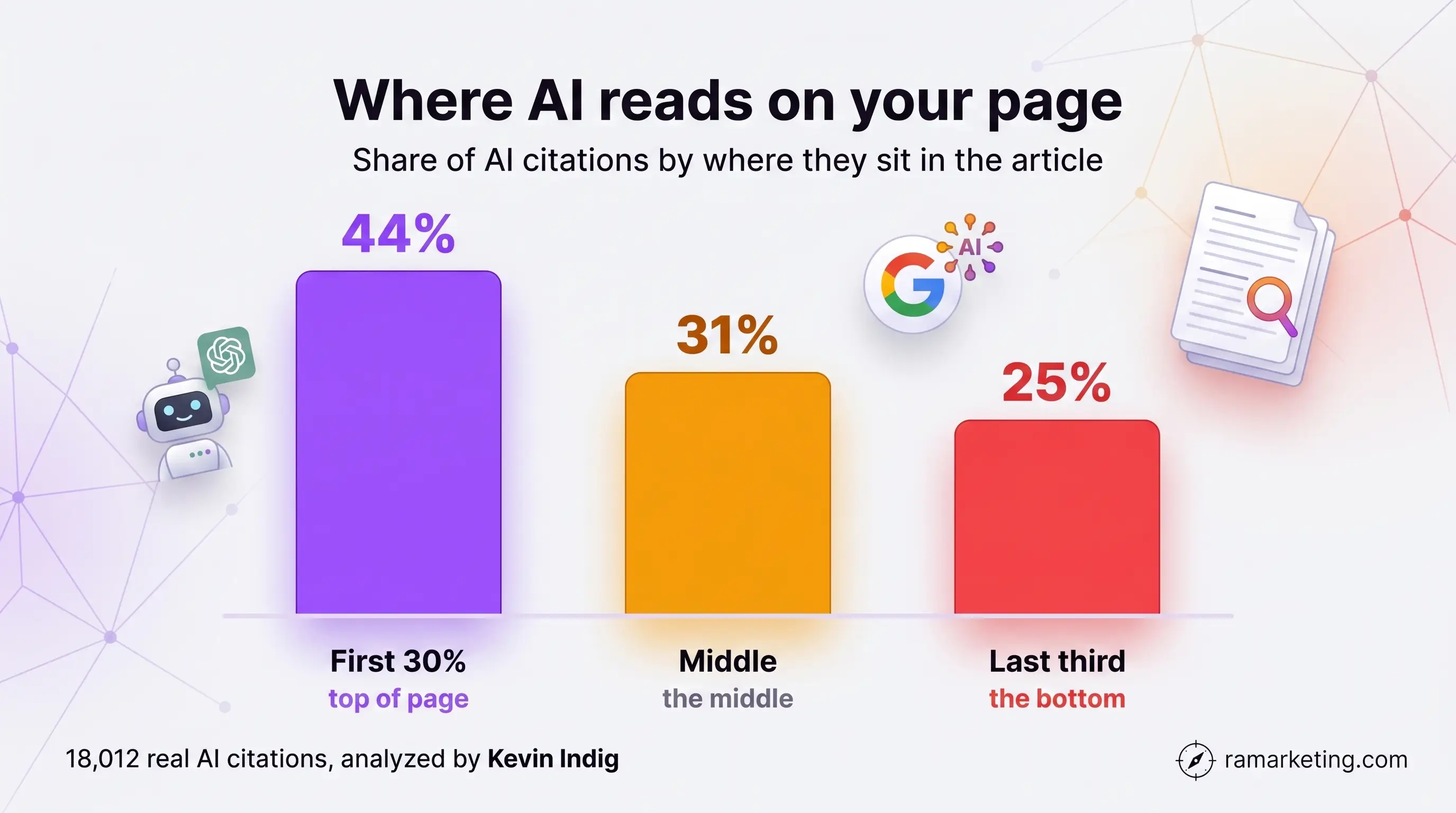
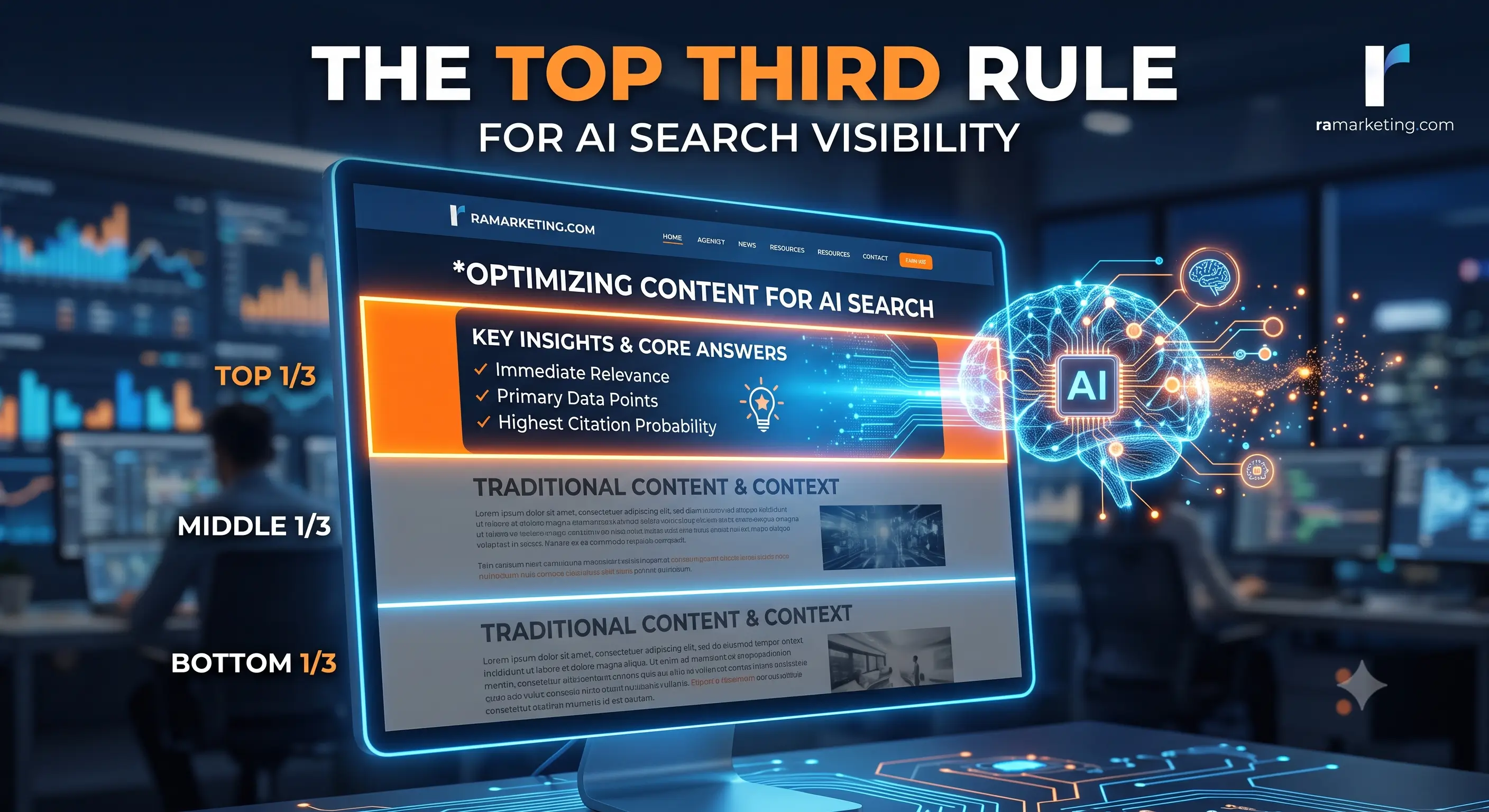
The Top Third Rule is a simple but ruthless structural mandate: If your core answer, primary insight, or most valuable data point isn’t located in the top third of your webpage, its chances of being cited by an AI engine plummet.
AI models are designed to parse billions of parameters in milliseconds. They prioritize immediate semantic relevance over everything else. When an AI search engine crawls your page to synthesize an answer for a user, it is looking for the highest concentration of accurate, direct information with the least amount of computational friction.
If your best insights are buried “below the fold” beneath stock photos, historical background, and meandering introductions, the AI will simply bypass your page and extract the answer from a competitor who got straight to the point.
Why Traditional Content Fails the AI Test
For years, traditional SEO trained content creators to use a “recipe blog” approach. We were taught to bury the actual recipe at the bottom of the page to force users to scroll, view ads, and increase time-on-page.
AI search fundamentally breaks this model.
| Feature | Traditional SEO Content | AI-First Content (Top Third Rule) |
| Structure | Narrative build-up leading to a conclusion | Inverted pyramid (Answer first, context later) |
| Goal | Maximize dwell time and scroll depth | Maximize immediate information extraction |
| Parsing | Humans scanning for keywords | AI synthesizing for direct relevance |
| Formatting | Text-heavy paragraphs | Bullet points, bold text, direct Q&A formats |
If you are writing for an AI, you are writing for an entity that has zero patience. It doesn’t care about your brand narrative until you have successfully answered its underlying query.
How to Audit for the Top Third Rule
Adapting to this new landscape doesn’t necessarily mean throwing out your existing content strategy. In fact, optimizing for the Top Third Rule is one of the easiest, highest-impact adjustments you can make to your current assets.
Here is how to audit your site today:
1. Identify Your Top-Performing Pages
Start with the pages that already drive your highest-intent organic traffic. These pages already have authority; they just need to be restructured for AI parsing.
2. Locate the “Buried Lede”
Read through the content as objectively as possible. Where is the actual “meat” of the article? Where are the proprietary statistics, the definitive definitions, or the actionable steps? In most cases, you’ll find them sitting in the middle or at the very bottom of the page.
3. Elevate and Condense
Move those core insights up. Immediately below your H1 (Main Title) and a brief 1-2 sentence hook, insert your core answer.
-
Use a “Key Takeaways” bulleted list.
-
Add a “TL;DR” summary box.
-
Directly answer the primary question the article poses in bold, clear language.
4. Push Context Below the Fold
You don’t have to delete the deep dives, historical context, or nuanced explanations. Simply push them beneath the core answer. Human readers who want the deep dive will scroll; AI engines who want the rapid answer will cite you.
The Future is Frictionless
We are rapidly moving away from a search environment where getting a user to click a blue link is the ultimate victory. The new victory is becoming the trusted source data that powers the AI’s answer.
Audit your top-performing pages today. Look at your H1s, your introductory paragraphs, and your above-the-fold real estate. If your best insights are buried, move them up. By adopting the Top Third Rule, you ensure that your brand remains visible, authoritative, and frequently cited in the AI-first search world.
Need help restructuring your content strategy for the AI-search era? Reach out to the team at ramarketing to future-proof your digital presence.